
Muscle-Sparing (Quad-Sparing) Knee Replacement in Mobile, Alabama
Muscle-sparing knee replacement — often called quad-sparing knee replacement — is a total knee replacement performed through an approach that passes underneath the quadriceps muscle instead of cutting through it. Dr. Russell Goode uses the subvastus approach: the vastus medialis is lifted off the intermuscular septum and the joint is entered beneath the muscle belly, so the quadriceps tendon and extensor mechanism are never divided.
The goal is faster early recovery. In randomized trials, patients treated through a subvastus approach regained an active straight leg raise about 1.7 days sooner than patients treated through the standard approach. Dr. Goode is a board-certified orthopaedic surgeon and a member of the American Association of Hip and Knee Surgeons. He sees patients at Gulf Orthopaedics’ Midtown Mobile office and performs muscle-sparing knee replacement at Mobile Infirmary and Saraland Surgery Center.
What is quad-sparing knee replacement?
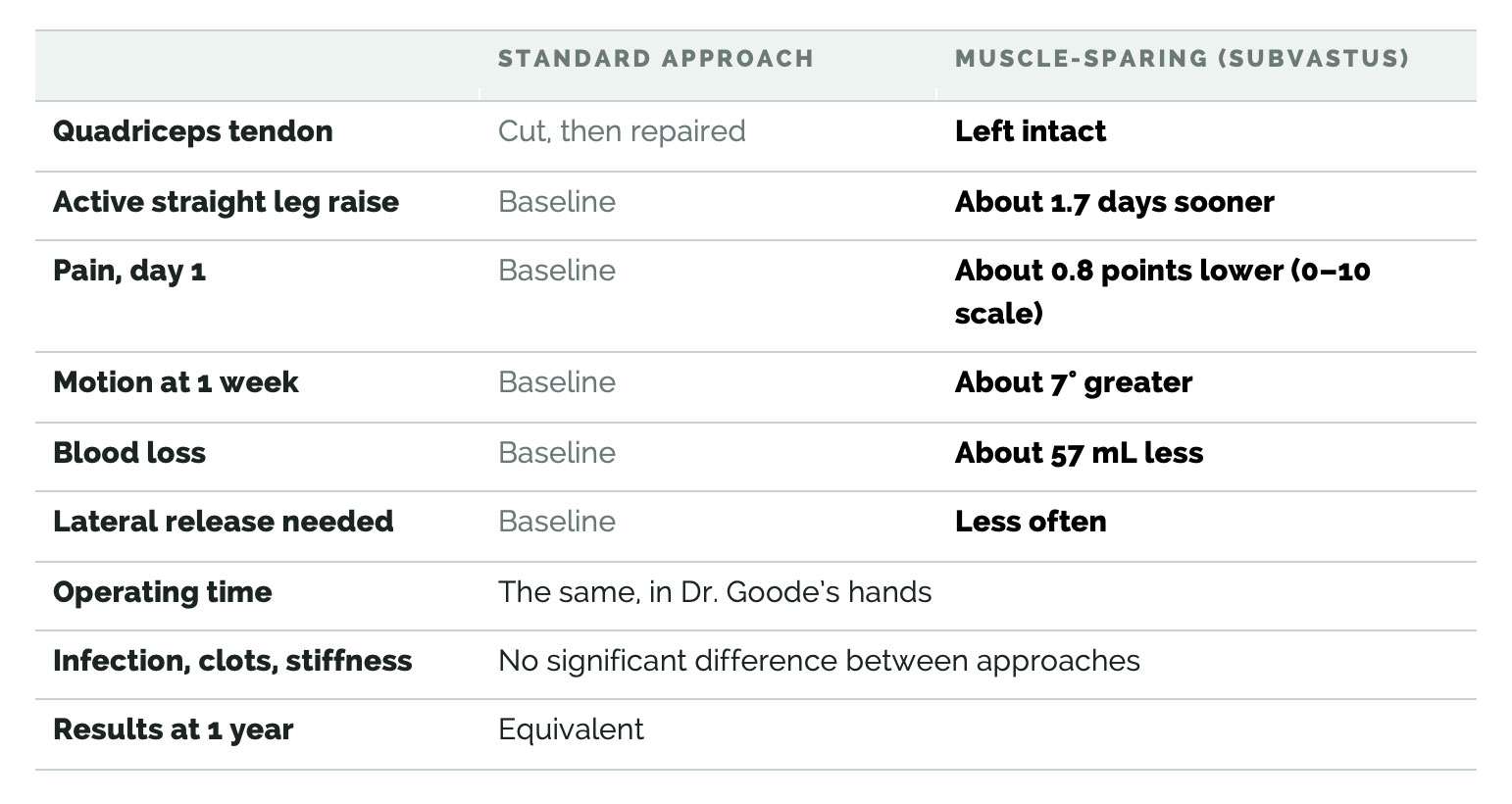
Quad-sparing knee replacement is a total knee replacement in which the surgeon reaches the joint without cutting the quadriceps tendon. In a standard total knee replacement — the medial parapatellar approach — the surgeon divides the quadriceps tendon and the inner edge of the quadriceps muscle in order to move the kneecap aside. In a muscle-sparing subvastus approach, the surgeon leaves that tendon intact and works beneath the vastus medialis instead.
The implant, the bone cuts, and the alignment goals are identical. What changes is the door used to get in. The quadriceps is the muscle you use to straighten your leg, lift it off the bed, and climb stairs — which is exactly why the door matters during the first few weeks.
How is it different from a standard knee replacement?
What does the research actually show?
Muscle-sparing approaches make the first few weeks measurably easier and produce results equivalent to the standard approach after about a year. Patients deserve both halves of that sentence.
A 2018 systematic review in EFORT Open Reviews pooled 20 randomized controlled trials covering 1,893 knee replacements. Compared with the standard medial parapatellar approach, the subvastus approach produced:
- an active straight leg raise about 1.7 days sooner
- about 0.8 points less pain on a 10-point scale on day one
- about 7 degrees more knee motion at one week
- about 57 mL less blood loss
- fewer knees requiring a lateral release
- no difference in infection, blood clots, or stiffness
Those trials also found the subvastus approach added roughly ten minutes to the operation. That reflects surgeons learning a less familiar approach. Dr. Goode uses it as his routine approach and completes these cases in the same operative time as a standard knee replacement.
A 2023 network meta-analysis of 33 randomized trials in The Journal of Arthroplasty reached the same conclusion: quadriceps-sparing approaches—the subvastus in particular—outperform the alternatives early, and the gap narrows over time.
What that means for you: choosing a surgeon who offers a muscle-sparing approach buys you a smoother first few months, not a different knee a year from now. Anyone promising more than that is overselling it.
Am I a candidate for muscle-sparing knee replacement?
Most patients who need a total knee replacement are candidates. The subvastus approach suits patients whose knee still bends reasonably well, whose deformity is moderate rather than severe, and whose body habitus allows safe exposure through a smaller window.
It is harder or inadvisable when there is:
- significant obesity, where the muscle envelope makes safe exposure difficult
- a very stiff knee or a fixed flexion contracture
- large varus or valgus deformity
- scarring from prior knee surgery, particularly a previous tibial tubercle osteotomy
- revision of a knee replacement that is already in place
This decision gets made in the operating room as well as in the clinic. If safe exposure is not possible through a subvastus approach, Dr. Goode converts to a midvastus approach, which still spares the quadriceps tendon by passing through the vastus medialis muscle rather than cutting the tendon. This protects against complications such as quadriceps tendon rupture—so even when the plan changes, the tendon stays intact.
Is this the same as robotic knee replacement?
No — they answer different questions, and they combine well. Robotic assistance is about where the implant goes: a 3D model of your knee and a computer-guided instrument plan to execute the bone cuts and soft-tissue balance to within a degree. A muscle-sparing approach is about how the surgeon reaches the bone.
Dr. Goode performs robot-assisted total knee arthroplasty through the muscle-sparing subvastus approach, so one operation gets both the precision of computer navigation and an intact extensor mechanism.
Can it be done as same-day, outpatient surgery?
Yes. Dr. Goode performs outpatient and 23-hour-observation total knee replacement at Mobile Infirmary and at Saraland Surgery Center. Appropriately selected patients go home the same day; others stay a single night under observation and go home the following morning.
Which option fits you depends on your medical history, whether someone can stay with you the first night, and how you do with therapy in the recovery area—not on the surgical approach alone. Medicare and most commercial plans cover outpatient total knee replacement.
What are the risks?
Muscle-sparing knee replacement carries the same risks as any total knee replacement: infection, blood clots, stiffness, persistent pain, nerve or blood vessel injury, implant loosening over time, and the possibility of further surgery. Randomized trials have not shown a higher complication rate with the subvastus approach than with the standard approach.
The approach-specific consideration is exposure. Working beneath the muscle gives the surgeon a smaller window, which is why patient selection — and a surgeon’s willingness to convert when needed — matters more here than the technique’s name.
Where does Dr. Goode see knee replacement patients?
All office visits — consultations, pre-operative planning, and follow-up — are at Gulf Orthopaedics’ Midtown Mobile office, 1720 Springhill Avenue, Suite 301, Mobile, AL 36604. Call (251) 435-BONE (435-2663).
Surgery is performed at Mobile Infirmary and at Saraland Surgery Center, serving Mobile and the surrounding Gulf Coast communities.
How do I schedule a consultation?
Call (251) 435-BONE (435-2663) or request an appointment online. Bring any knee X-rays or MRI reports from the past year. Whether you need a referral depends on your insurance plan — our office can check for you when you call.